
Research / 01
InterviewDx
Scaffolding Candidates from AI-Assisted Feedback and Dialogue to Independent Interview Practice
InterviewDx scaffolds candidates from evidence-grounded feedback, through candidate-directed dialogue, to independent practice while preserving their responsibility for evaluating feedback and producing responses.
- Inspect
- Discuss
- Practice
- Question
- How can AI-assisted interview coaching provide useful feedback and adaptive support without displacing the evaluative and productive work candidates must ultimately perform themselves?
- Approach
- We conducted a two-cohort formative study to understand how job seekers interpret and act on interview feedback, then designed InterviewDx around evidence-grounded feedback, candidate-directed dialogue, and independent practice. We evaluated it against open-ended AI practice in a randomized between-subjects pre–post study with 40 participants.
- Contribution
- InterviewDx proposes AI-assisted scaffolding for open-ended interview practice: make feedback claims inspectable, let candidates contribute context that shapes subsequent support, and explicitly return response production to the candidate through an unaided practice attempt.
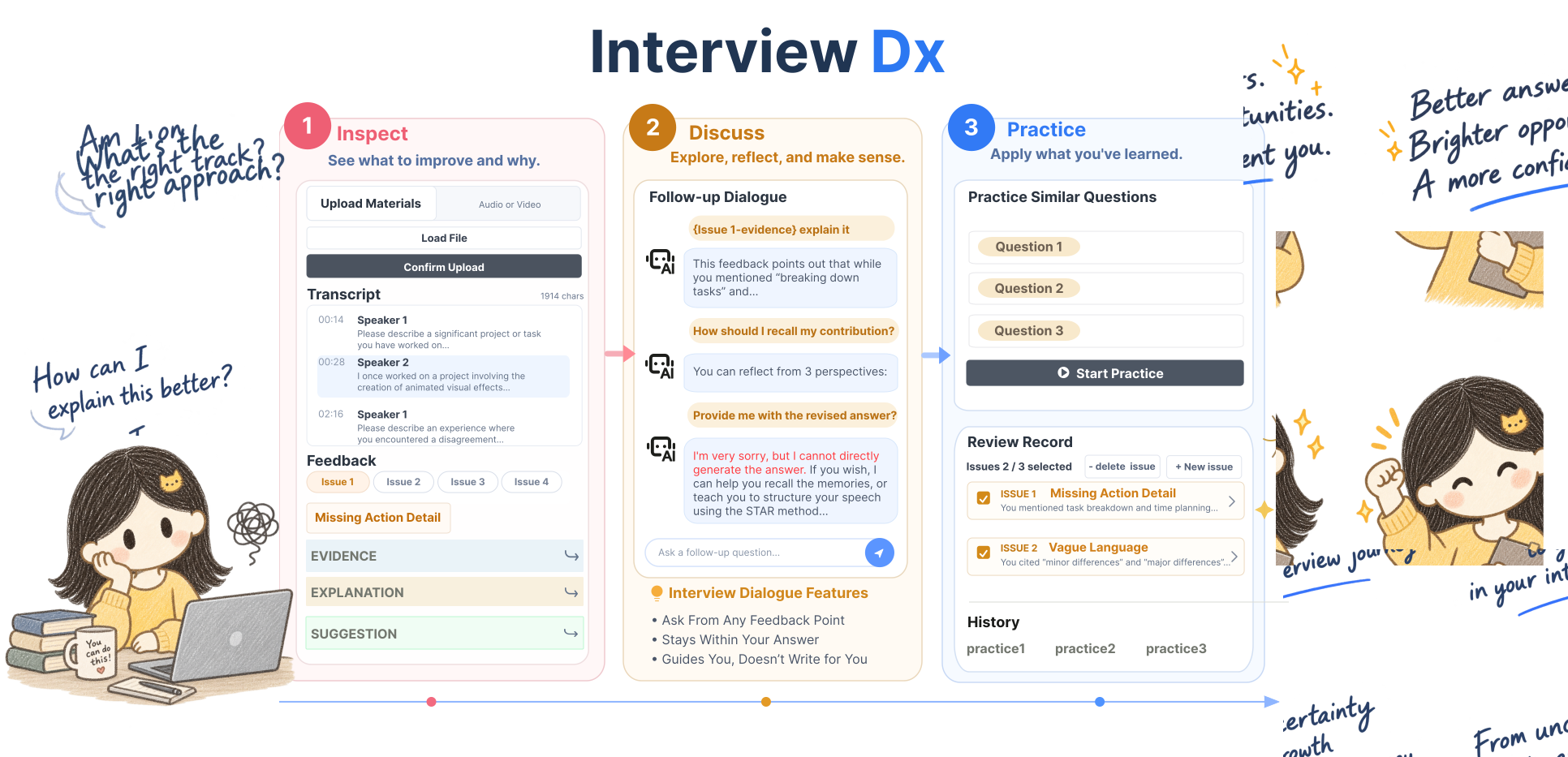
Why Feedback Alone Is Not Enough
Receiving guidance does not by itself ensure that candidates interpret it, judge its relevance, or transfer what they learned into their own response production.
Interview practice requires candidates to interpret questions, retrieve relevant experiences, and organize them into coherent, experience-grounded responses under pressure. Structured practice and feedback can improve performance, but receiving feedback does not guarantee that candidates actively evaluate or apply it.
LLMs can provide open-ended feedback and dialogue, but greater assistance does not necessarily produce independent learning. AI-assisted gains may fail to transfer when support is removed, while open-ended systems may provide generic feedback or place too much burden on users to steer the interaction.
The design problem is therefore not simply how to give better feedback, but how to help candidates work through feedback themselves and then perform without AI assistance.
System Architecture
InterviewDx connects the learning progression to concrete user actions and system components.
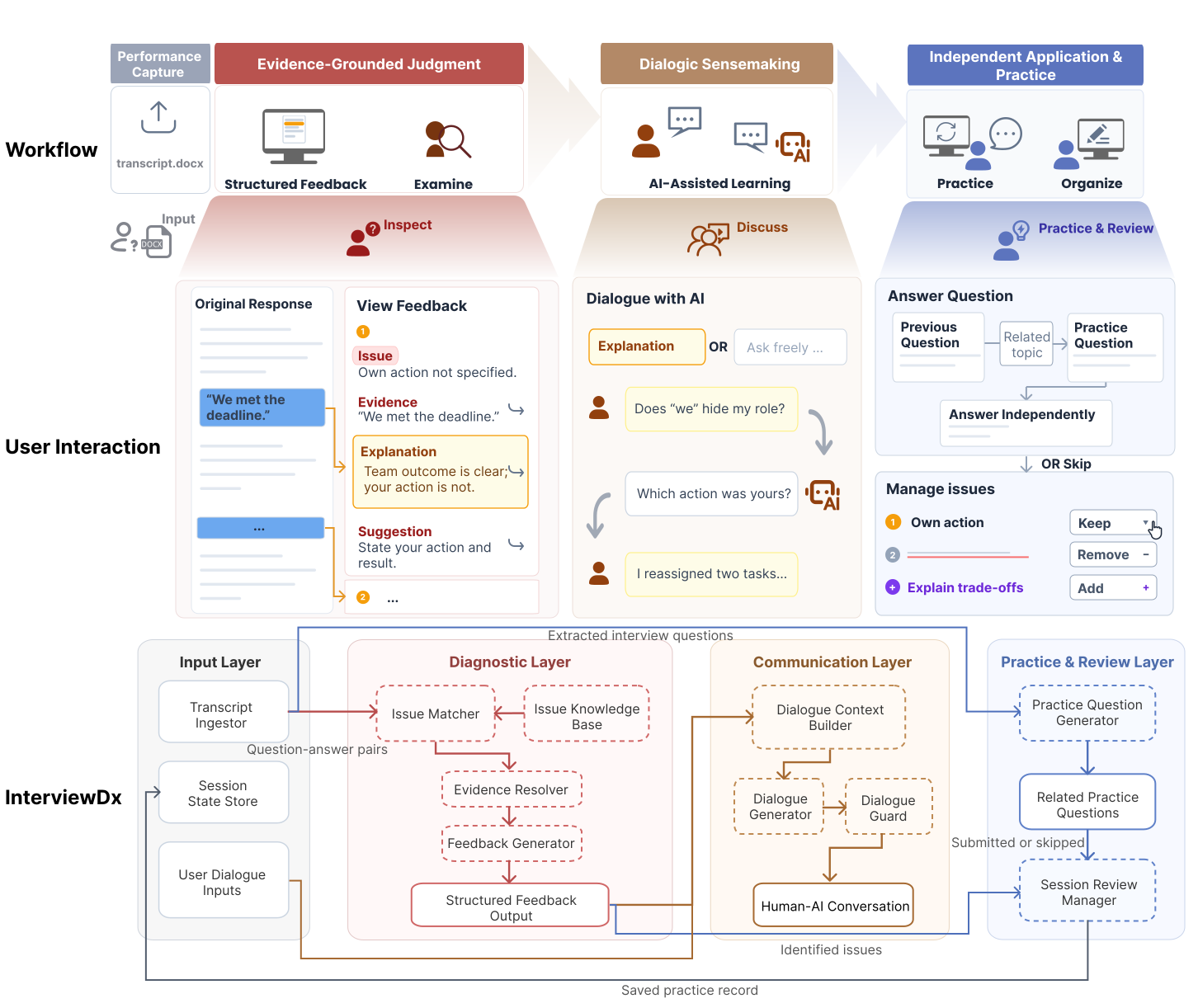
Workflow
Performance Capture → Evidence-Grounded Judgment → Dialogic Sensemaking → Independent Application & Practice
User interaction
Input → Inspect → Discuss → Practice & Review
System components
At the system level, InterviewDx combines an Input Layer, Diagnostic Layer, Communication Layer, and Practice & Review Layer. Structured feedback is grounded in the candidate's original response; dialogue incorporates the candidate's questions and contributed context; related practice questions then return response production to the candidate.
Design Principles
The scaffold must keep feedback inspectable, make dialogue candidate-directed, and return response production to the candidate in a subsequent attempt.
Evidence-grounded and inspectable judgment
AI judgments should use explicit and stable evaluation dimensions, remain bounded to the response under review, and link each identified issue to observable evidence. Each issue should explain why it matters and provide a direction for revision without deciding for the candidate whether the feedback should be accepted.
Candidate-directed dialogic sensemaking
Candidates should be able to question specific feedback, raise concerns, and provide additional context such as project details or job requirements. Subsequent support should adapt to what candidates ask or contribute rather than deliver all explanation in a single pass.
Independent application and practice
The system should provide an explicit subsequent attempt while preserving the candidate's responsibility for producing the response. This creates an opportunity to apply feedback without replacing candidate effort with a fully revised answer.
Experience Walkthrough
The interface keeps the original response, the AI's judgment, and the candidate's subsequent work visibly connected.
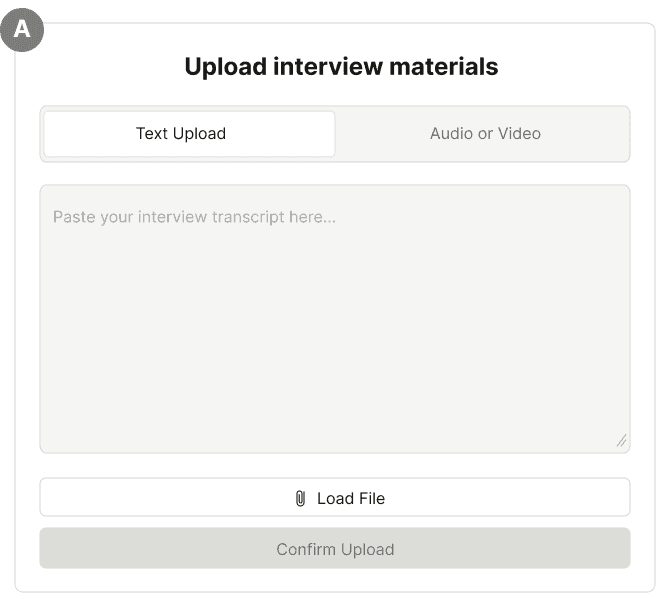
A
Upload
Candidates provide their interview material.
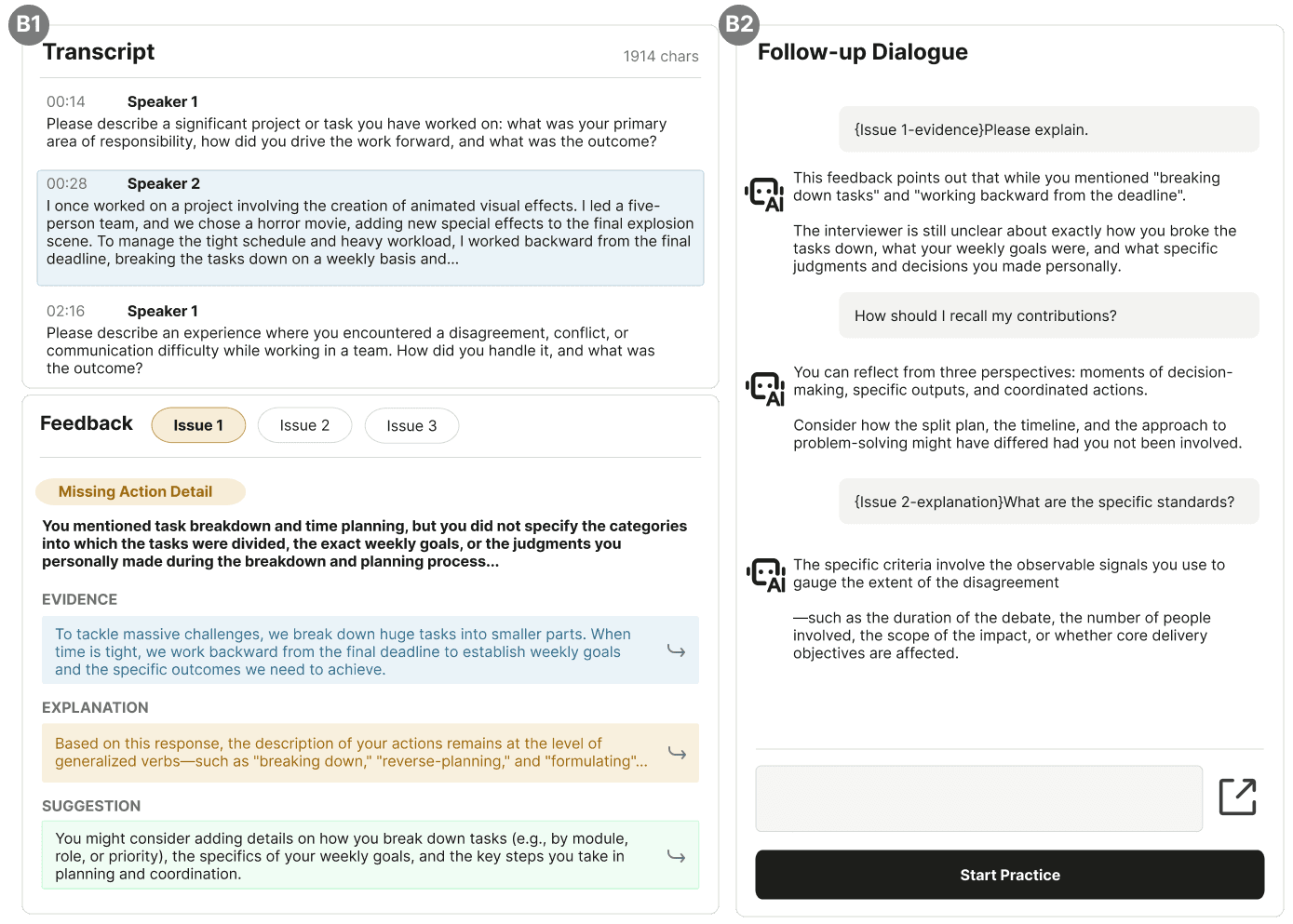
B1–B2
Inspect issue and follow-up dialogue
The original response is displayed alongside structured feedback containing four components: Issue, Evidence, Explanation, and Suggestion. Candidates can ask questions anchored to a feedback component or formulate their own questions while continuing to inspect the original response and feedback.
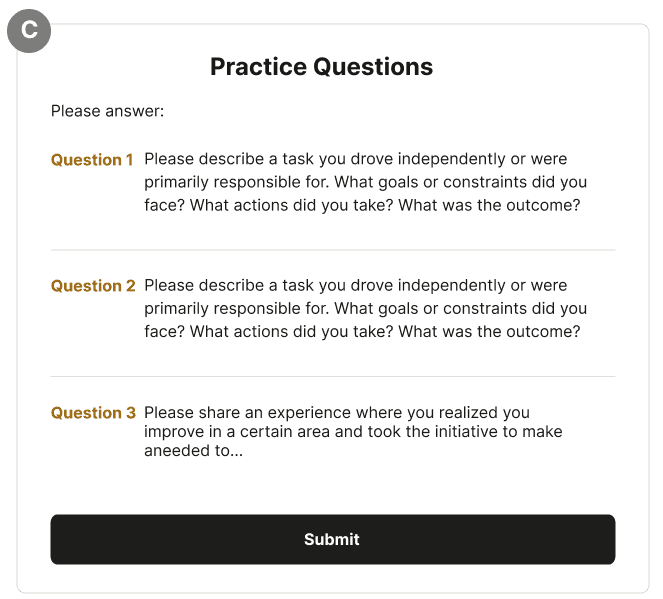
C
Independent practice
Candidates answer practice questions independently, without access to feedback or dialogue.
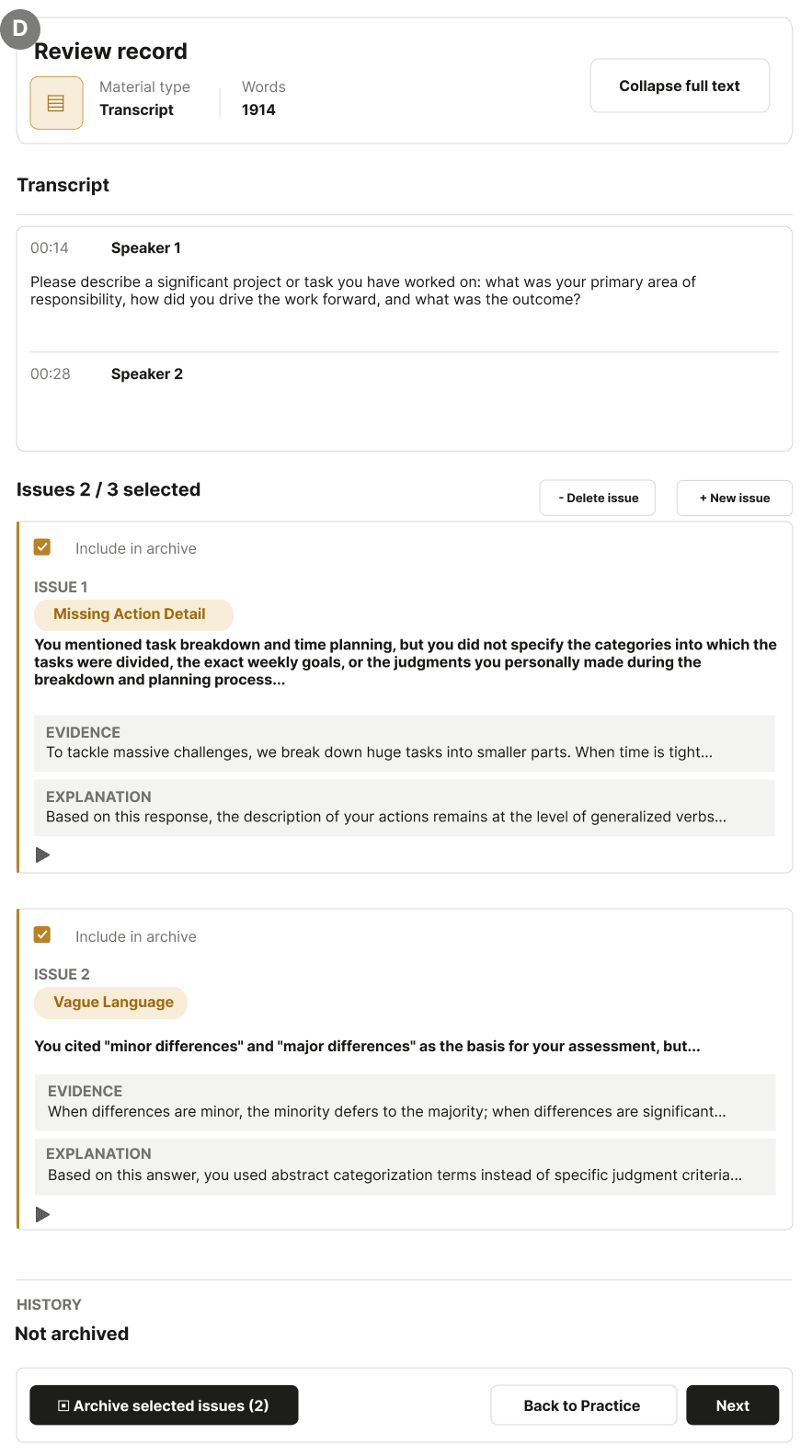
D
Review
Candidates review and organize the issues retained in their practice record.
Study Design
We compared InterviewDx with open-ended AI practice while holding the underlying language model constant.
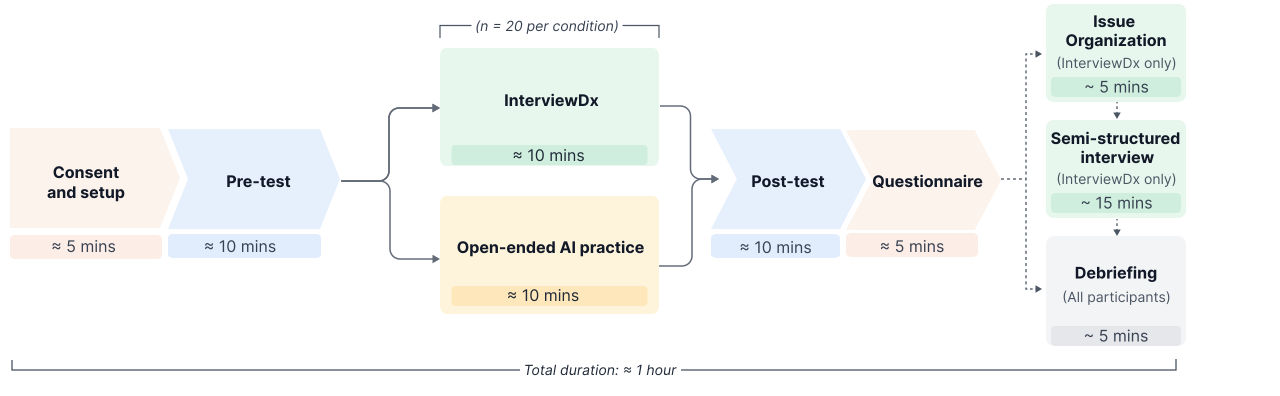
Both conditions used the same frozen language model and required at least three participant-authored dialogue turns. Participants completed three standardized interview questions at pre-test and three at post-test. Post-test responses were produced independently without AI assistance.
Shared timeline
Consent & Setup → Pre-test → AI-Supported Practice → Post-test → Questionnaire → Debriefing.
InterviewDx-only steps
InterviewDx participants additionally completed Issue Organization and a Semi-structured Interview.
Key Findings
InterviewDx improved how participants experienced AI support and showed a positive advantage in unaided post-test performance.
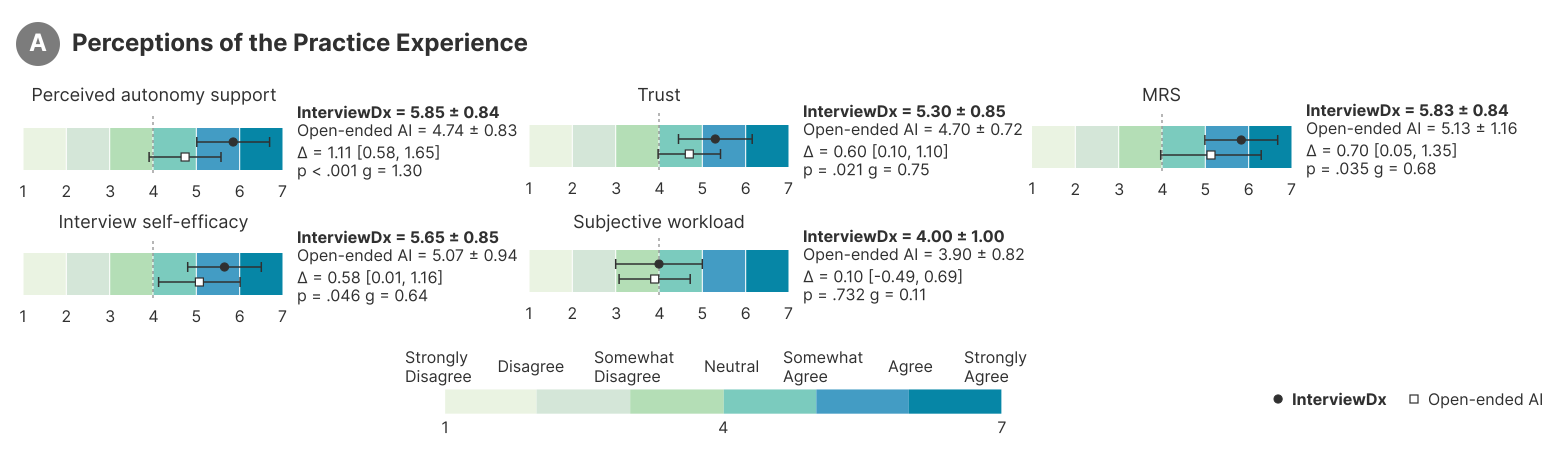
Participants reported stronger autonomy support, trust, metacognitive reflection support, and interview self-efficacy with InterviewDx.
Evidence
The largest difference was perceived autonomy support: Δ = 1.11, 95% CI [0.58, 1.65], Hedges' g = 1.30, p < .001. Trust, MRS, and interview self-efficacy also favored InterviewDx, while subjective workload did not clearly differ. Autonomy support: InterviewDx 5.85 ± 0.84 vs Open-ended AI 4.74 ± 0.83; Trust: 5.83 ± 0.84 vs 5.13 ± 1.16; MRS: 5.30 ± 0.85 vs 4.70 ± 0.72; Self-efficacy: 5.65 ± 0.85 vs 5.07 ± 0.94; Workload: 4.00 ± 1.00 vs 3.90 ± 0.82.
Interpretation
The main differences concerned participants' experience of the quality and structure of support rather than reduced workload.
InterviewDx showed a positive advantage in independently rated post-test performance.
Evidence
Baseline-adjusted estimate: +0.234 points, 95% CI [-0.013, 0.481], p = .062, partial η² = .091.
Interpretation
After AI support was removed, post-test performance still favored InterviewDx over open-ended AI practice.
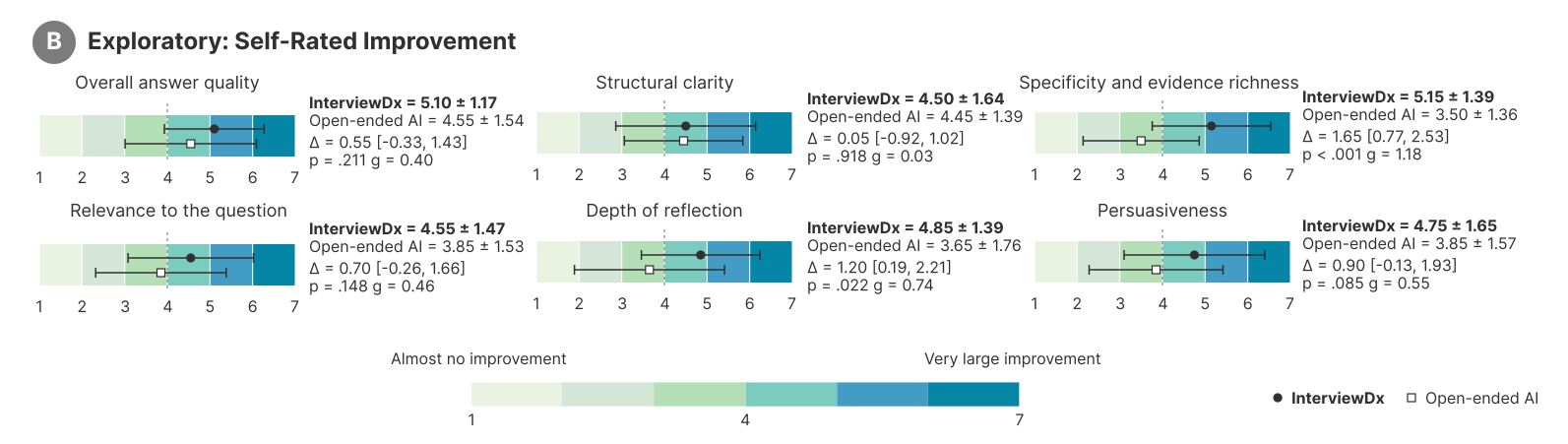
InterviewDx received higher ratings for specificity, evidence richness, and depth of reflection.
Interpretation
Participants experienced the feedback as more tightly tied to their own responses and more useful for thinking issues through, rather than as a generic evaluation.
How People Used Dialogue
InterviewDx dialogue contained a broader range of conversational actions than open-ended AI practice.
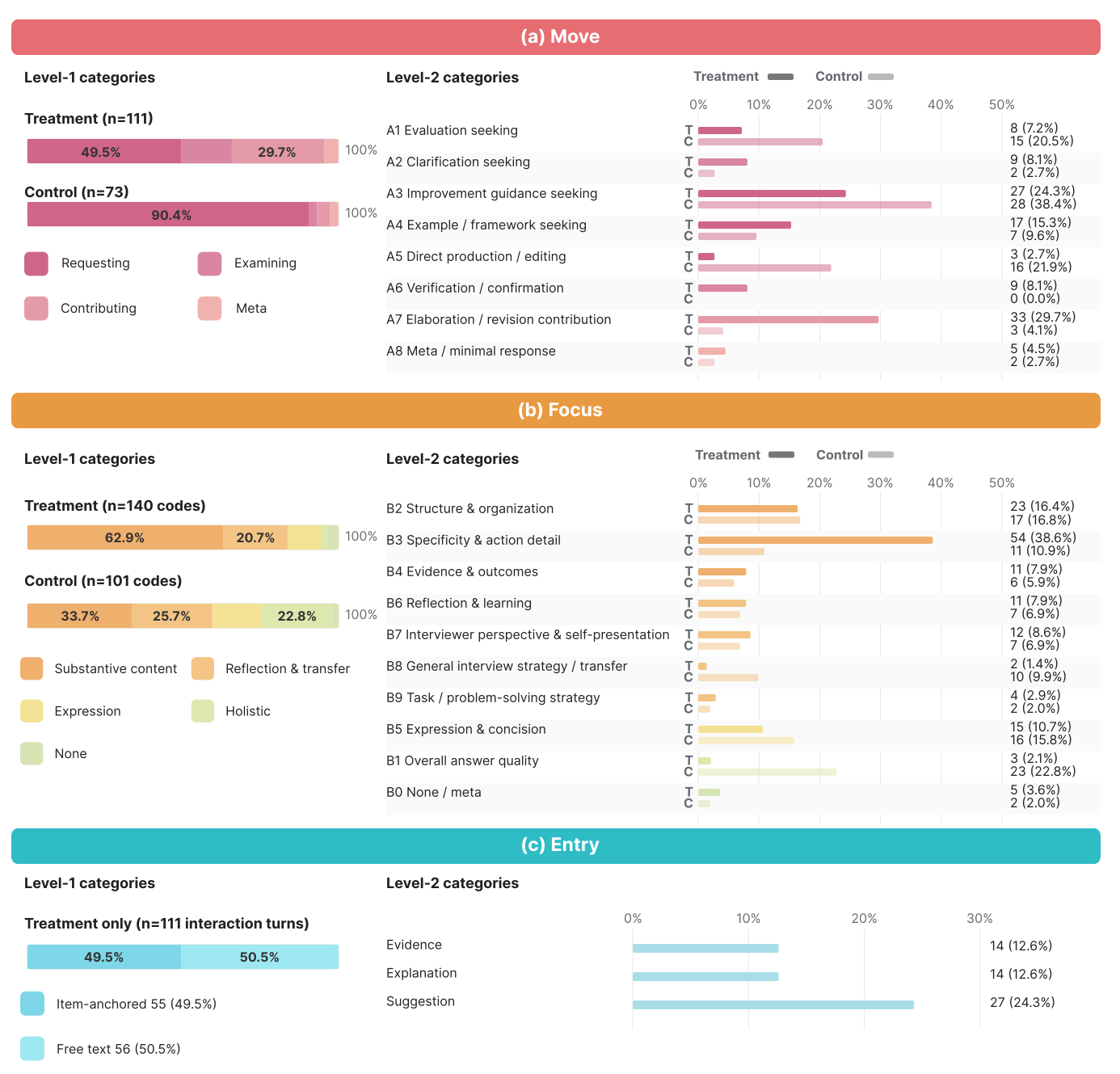
Open-ended AI dialogue was dominated by requests for AI support, while InterviewDx included more feedback examination and participant contribution.
Evidence
Across 184 participant-authored turns, requests for AI support were 90.4% in Open-ended AI and 49.5% in InterviewDx. Participant contribution: 29.7% vs 4.1%. Examination of prior feedback: 16.2% vs 2.7%. Within InterviewDx, item-anchored and free-text entries were almost equally common: 55 vs 56 turns. Structured feedback was also explicitly inspected: 18 turns across 13/20 sessions involved clarification or verification, and 16/18 began from a specific feedback item. Participant contribution occurred in 33/111 InterviewDx turns, often involving concrete experiences, actions, or revisions rather than simply requesting additional AI output.
Interpretation
When feedback is an inspectable object and dialogue can start from a specific item, candidates more often examine judgments and contribute their own material instead of continually requesting the next AI output.
Contribution
Feedback grounding
Make AI feedback inspectable rather than self-validating.
Claims remain tied to observable response evidence, explicit criteria, explanations, and revision directions that candidates can examine and contest.
Dialogic scaffolding
Let candidates help determine what support should come next.
Dialogue allows missing context and learner needs to emerge after initial feedback, enabling support to become partly candidate-driven and contingent.
Independent transfer
Return productive responsibility to the candidate.
A subsequent unaided attempt makes independent response production part of the scaffold rather than assuming that understanding feedback is sufficient.